
Did goblins move Rochdale Parish Church up the hill?
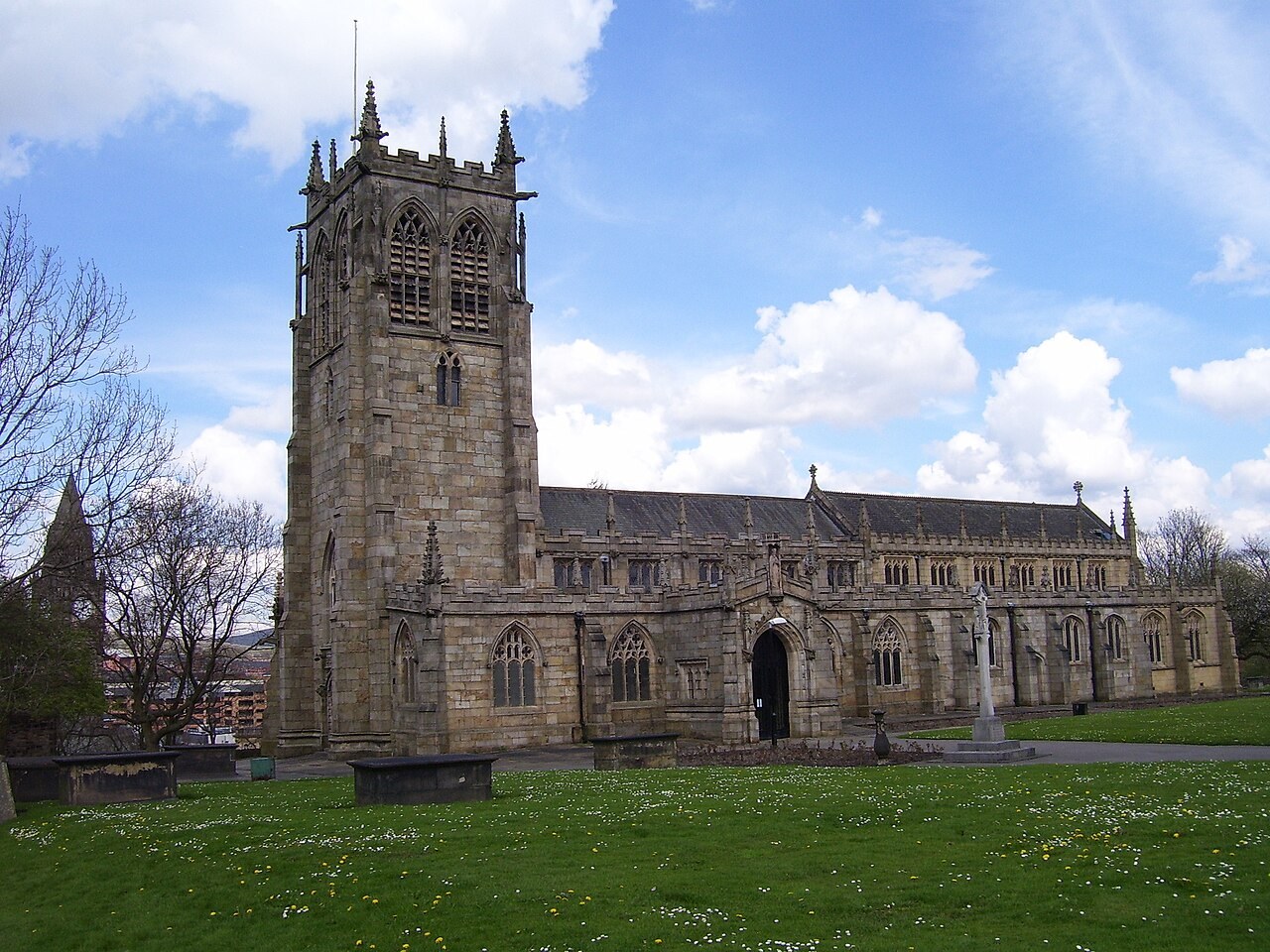

A long-told local tale says unseen workers carried building stones overnight to the top of the hill; the record shows a medieval church, later Victorian work, and a 19th‑century storyteller rather than supernatural masons.
The short answer is: no, there is no evidence that goblins or other supernatural creatures physically moved the stones of St Chad’s Church.
That story belongs to Lancashire folklore, best known from the 19th‑century collector John Roby, while the documentary and architectural record shows a long‑standing church site with medieval fabric and later restorations. ([gutenberg.org](https://www.gutenberg.org/files/15271/15271-h/15271-h.htm))
Roby’s version of the tale — titled “The Goblin Builders” in his Traditions of Lancashire — describes a Saxon thane, piles of building stone laid by the river, and those materials mysteriously transferred overnight to the hill where St Chad’s now stands; Roby also notes the famous flight of steps (he records 124) leading up to the church.
That account is a clear piece of local storytelling rather than a contemporary record of building work.
Roby wrote in the 19th century as a folklorist and compiler of oral tradition; his retelling preserves how people in his era understood the place, not the legal or archaeological history of its masoning. ([gutenberg.org](https://www.gutenberg.org/files/15271/15271-h/15271-h.htm))
The documented history of the building is plain and far less sensational.
Historic England lists St Chad’s as Grade II* and describes medieval and post‑medieval construction phases: a thirteenth‑century tower, fourteenth‑century arcade columns and arches, a clerestory dated 1557, and substantial Victorian restorations and additions in the 19th century.
Those layers — Norman and medieval masonry altered, repaired and refashioned over centuries — explain the church’s position and appearance more plausibly than an overnight relocation by invisible hands. ([historicengland.org.uk](https://historicengland.org.uk/listing/the-list/list-entry/1045812))
Why on the hill? Practical and symbolic reasons usually guided medieval siting.
A high position overlooks the river and the town, keeps the building clear of floodplain, and gives the church civic and visual prominence; these are the kinds of factors architectural historians use when they discuss hilltop parish churches, and they match the description of St Chad’s occupying high ground above the River Roch.
The building’s long use as the mother church of the ancient parish of Rochdale — serving a large rural parish for many centuries — also favoured a prominent site. ([historicengland.org.uk](https://historicengland.org.uk/listing/the-list/list-entry/1045812))
That is not to say the legend has no local value.
Roby’s telling and other versions preserve a communal memory that the church’s siting felt important enough to explain with a story; the goblin motif is widespread in English folklore as a way to name unexplained or surprising events.
Local guides and walking routes still point out the steps and repeat the tale; it’s part of how Rochdale people have talked about their church across generations. But folklore and documentary history are different tools: the former explains meaning, the latter records evidence.
([gutenberg.org](https://www.gutenberg.org/files/15271/15271-h/15271-h.htm))
If you want to check the facts in person: the parish continues to use St Chad’s as Rochdale Parish Church, and the building, its steps and the churchyard are publicly accessible; the parish’s information pages list services and contact details.
For the architectural inventory, Historic England’s official list entry gives the formal description and dating used by planners and conservators.
If any reader is curious about the Roby story itself, his Traditions of Lancashire is available in full online as a 19th‑century account of local legend. ([rochdalecommunity.org.uk](https://rochdalecommunity.org.uk/sites/saint-chad-rochdale-parish-church/))
Sources
Read next
 Community103-year-old D-Day veteran shares his story at Rochdale church event
More from Rochdale
 Rochdale deputy council leader detained twice in Pakistan
 Letchworth Avenue closed to vehicles for roadworks until 14 December
 Rochdale White Ribbon vigil: where Wednesday's walk starts and how to joinThinking about fostering? Free advice stall at Rochdale Riverside on WednesdayMorning Briefing: Monday 23 November 2026
More CommunitySee all ›
Middleton Library to explore ghost stories and the real history behind themRochdale Masters and Mayfield Movers raise nearly £15,000 in charity walks Rochdale AFC launches Christmas Toy Appeal for local families in needWinter Wood Grotto returns to Rochdale with new seasonal show
 Rochdale's Springhill Hospice wins three garden awards
Legal and editorial note
This article was compiled from identified public sources and may be updated when further verified information becomes available.
Right to reply: For corrections or a right of reply, email news@rochdaledaily.co.uk.